Key takeaways
- The best first uses of AI in an arts organization are practical ones that save staff time, like answering visitor questions, drafting first versions and moving data between systems.
- Every department can benefit, from front of house and development to marketing, operations and leadership, but you should start with one focused project, not all of them at once.
- AI should draft, sort and suggest while people review, decide and publish, especially for anything public-facing or involving donors and artists.
- Costs stay manageable when you pick one problem with clear value, use business AI plans that protect your data, and grow only when the first project pays off.
- Avoid AI that invents facts, publishes without review, or puts patron and donor data into consumer tools that may use it for training.
AI can help arts organizations most by taking repetitive work off small teams: answering visitor questions around the clock, drafting grant reports and marketing copy for staff to review, and moving data between ticketing, CRM and email systems. The right way to start is small: one focused project with clear value, people in charge of every decision, and your patron and donor data protected from the beginning.
This guide walks through where AI genuinely helps, department by department, how to choose a first project, what to avoid, and how to think about cost.
Why should arts organizations care about AI now?
Theaters, orchestras, museums and arts nonprofits do remarkable work with small teams. The same few people answer the box office inbox, write the grant report, schedule the social posts and pull the numbers for the board meeting. Much of that work is necessary but repetitive.
AI tools have become good at exactly this kind of work: reading your own material, answering questions about it, drafting first versions and connecting systems that don’t talk to each other. They are not good at judgment, relationships or art. That split is useful. It means AI can give your team time back for the work only people can do.
There is also a visibility reason. More people now ask ChatGPT, Gemini and Google’s AI answers what to see this weekend or which museum is open late. If your organization’s information is hard for those assistants to read, you are missing from the conversation. We cover that in detail in how arts organizations get found in AI search.
Where can AI help each department?
The most useful way to think about AI is by job, not by tool. Here is where it tends to help, team by team.
| Department | What AI can take on | What people still own |
|---|---|---|
| Front of house | Answering questions about tickets, hours, parking and accessibility, 24/7 and in multiple languages | Complex requests, complaints, exceptions |
| Development | First drafts of grant reports, donor briefings, acknowledgment letters | Relationships, asks, final approval |
| Marketing | Social posts, newsletters, ad variations, alt text and captions in your voice | Creative direction, publishing |
| Operations | Syncing data between systems, reading invoices and forms | Exceptions, financial decisions |
| Leadership | Plain-English questions about sales, attendance and giving data | Strategy and decisions |
| Growth | Making your content readable by search engines and AI assistants | Messaging and priorities |
Front of house: a visitor assistant that never sleeps
Your box office and visitor services staff answer the same questions every day. When does the show end? Is there step-free access? Can I bring a stroller? A well-built AI assistant on your website can answer these from your own content, at any hour, in your visitors’ languages.
The key words are “from your own content.” A good assistant is grounded in your visitor guide, FAQ pages and policies, and it is set up to say “I don’t know” and hand off to a person when it should. We describe how this works on our AI chatbot page. If you use Tessitura®, an assistant can go further and check live availability and pricing; see our guide to AI chatbots for Tessitura box offices.
Development: first drafts, not final words
Grant writing and donor research take hours of careful, structured writing. AI can turn your program data and past reports into a first draft of a grant narrative, summarize a foundation’s guidelines, or prepare a briefing before a donor meeting. Your development staff then edit, correct and decide.
This works well because the structure is predictable and the source material is yours. It works badly when the AI is asked to invent outcomes or fill gaps. We go deeper in AI for grant writing and donor research.
Marketing: content in your voice
Marketing teams can use AI to turn program notes into a week of social posts, write three versions of an email subject line, or draft alt text for every image. With your style guide and past work as reference, the drafts sound much more like you.
The rule here is simple: drafts for your team, never auto-published. Your audience notices when something sounds off.
Operations: ending the copy-paste
Many arts organizations still re-type data from one system into another: ticket buyers into the email platform, invoices into accounting, form submissions into a spreadsheet. Business automations connect those systems so data moves on its own, and AI can read documents like invoices and contracts so nobody has to type them.
This is rarely glamorous, but it is often where the most hours come back.
Leadership: asking your data in plain English
Executive directors and board members often wait days for a report. With secure, permissioned access, an AI assistant like ChatGPT, Claude or Gemini can answer questions such as “How did subscription renewals this year compare with last year?” directly from your systems. Start with read-only access and log every question. If your data lives in Tessitura, see how to connect Tessitura to Claude, ChatGPT and Gemini with MCP.
How should a small team get started?
The organizations that get real value from AI tend to follow the same pattern.
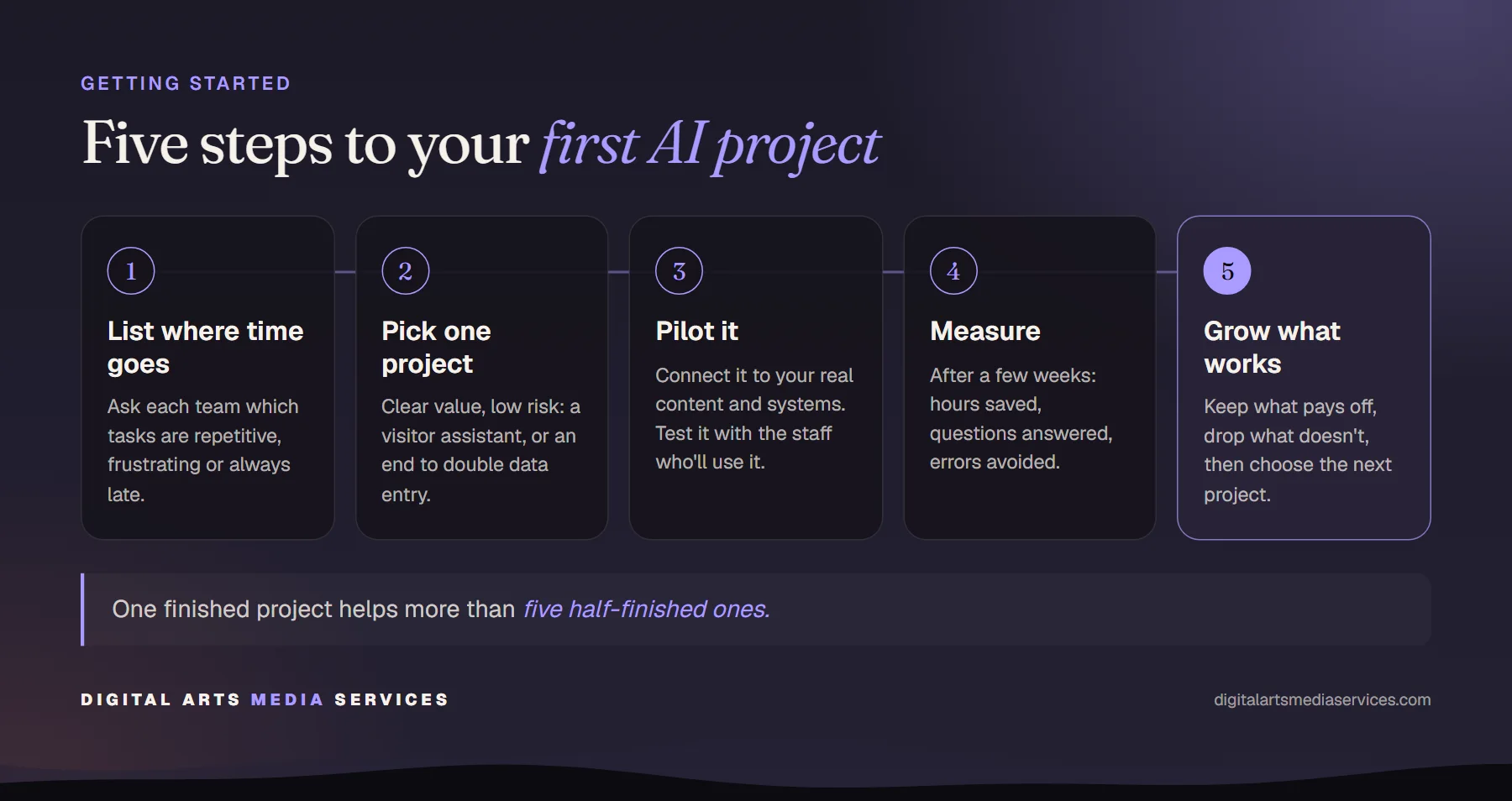
- List where time goes. Ask each team which tasks are repetitive, frustrating or always late. You will usually hear the same few answers.
- Pick one project. Choose something with clear value and low risk. A visitor assistant or an automation that removes double data entry are common first choices.
- Pilot it. Build it connected to your real content and systems, and test it with the staff who will use it.
- Measure. After a few weeks, check the hours saved, the questions answered or the errors avoided. Ask your team whether it actually helps.
- Grow what works. Keep what pays off, drop what doesn’t, and choose the next project.
Before you start, it helps to agree on some ground rules. Our guide on how to write an AI policy for your arts organization includes a short template you can adapt.
What should arts organizations avoid?
Most AI problems in the arts come from a handful of avoidable mistakes.
- Letting AI publish on its own. Anything public-facing, from a social post to a donor letter, should be reviewed by a person first.
- Trusting answers without sources. AI can state wrong facts confidently. Assistants should answer from your own content and admit when they don’t know.
- Putting sensitive data into consumer tools. Free chat apps may use what you type to improve their models. Patron and donor data belongs only in business plans and systems you have approved.
- Using artists’ work or likeness without consent. Don’t generate images, voices or text in the style of a specific artist, or feed their work into AI tools, without clear permission.
- Buying a tool before defining the problem. Start with the job that needs doing, then choose the tool.
- Trying to do everything at once. Five half-finished AI projects help no one. One finished project does.
How much does AI cost for an arts nonprofit?
You don’t need a large budget to begin. The costs usually fall into three parts:
- Setup: connecting the AI to your content and systems, configuring what it may and may not do, and testing it. This is where a partner usually helps.
- Usage: what the AI provider charges for each request. For many focused projects this is modest, and some platforms let you bring your own AI key so you pay the provider directly.
- Care: keeping content up to date, reviewing what the AI does and improving it over time. This is mostly staff time, and it matters.
The best way to keep costs in check is to start with one project where the value is easy to see, such as hours saved each week or questions answered after hours, and to expand only when the first one has paid off.
How do you keep people in charge?
The principle that matters most is simple: AI drafts, sorts and suggests. People review, decide and publish.
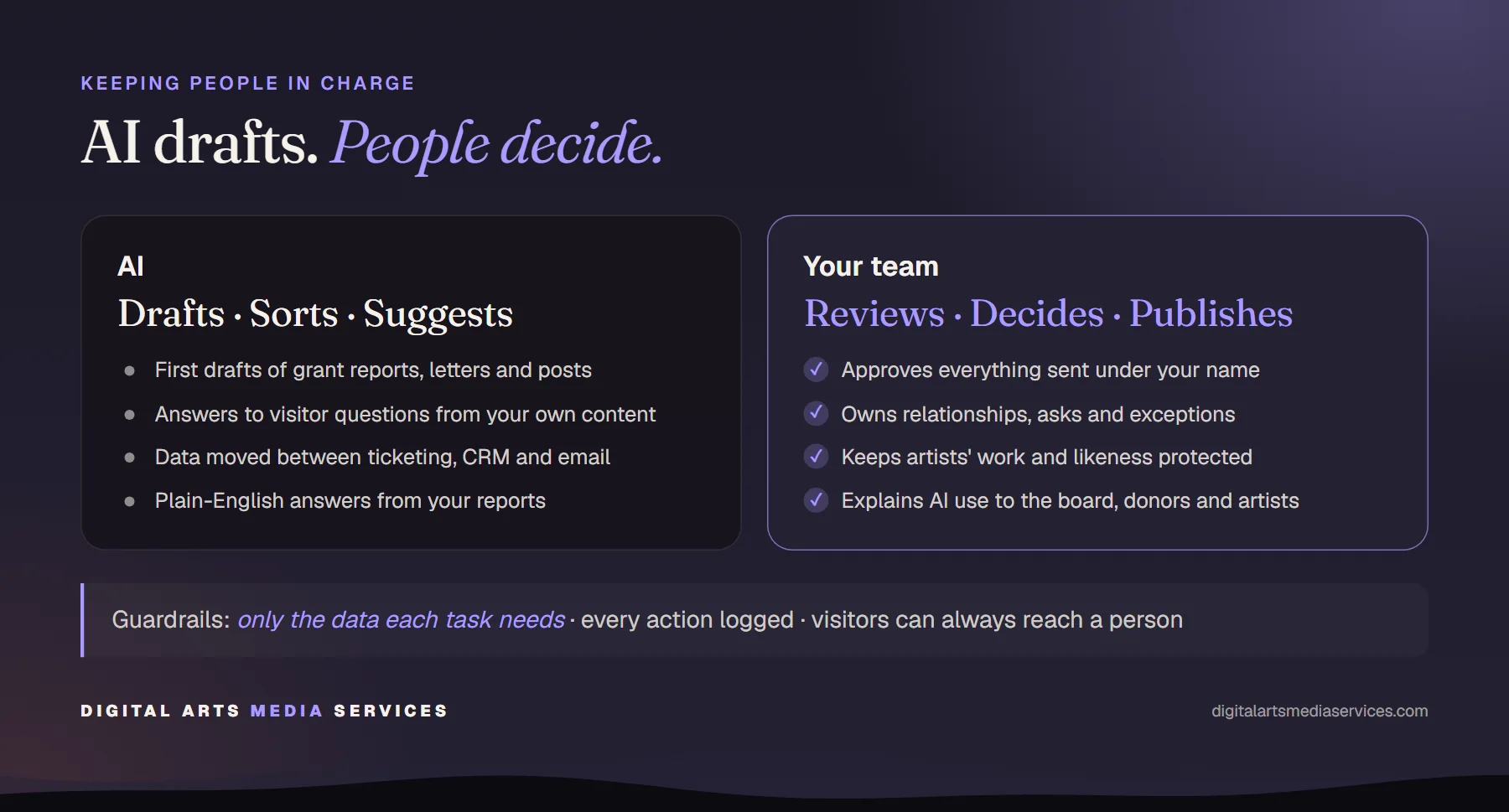
In practice, that means:
- Staff approve anything that goes out under your name.
- AI tools only see the data each task needs.
- Every action an AI takes in your systems is logged.
- Visitors can always reach a person.
- You can explain to your board, your donors and your artists exactly how AI is used.
Arts organizations run on trust from audiences, donors, artists and funders. Used this way, AI helps you keep it while giving your team time back.
Where to go from here
If you are wondering where AI could help your organization first, we’re happy to talk it through. We’ve worked with arts organizations since 2009, and our AI for arts organizations page shows what we build. The first conversation is a free consultation, and we’ll suggest two or three practical places to start. Get in touch.
Frequently asked questions
What is the easiest way for an arts organization to start using AI?
Pick one repetitive task that costs your team real hours, such as answering the same visitor questions or drafting routine reports, and run a small pilot on it. Measure the time saved after a few weeks. If it works, keep it and move on to the next task.
Do we need a technical team to use AI?
No. Many useful tools, like a website assistant or AI writing help, can be set up by a partner and used by non-technical staff. You do need someone who owns the project, checks quality and decides what the AI is allowed to do.
Can AI help a small museum or theater with marketing?
Yes. AI can turn program notes or exhibition text into first drafts of social posts, newsletters and ad variations in your house style, and it can draft alt text and captions. A person should always review and publish the final version.
Is it safe to use AI with patron and donor data?
It can be, if you set it up carefully. Use business plans from AI providers that exclude your data from model training, limit the AI to the data each task needs, and log what it does. Never paste donor or patron records into free consumer chat tools.
How much does AI cost for an arts nonprofit?
It depends on the project, but you do not need a large budget to start. Many organizations begin with one focused project and pay the AI provider directly for what they use. Start small, measure the value, and only expand what pays off.