Key takeaways
- AI assistants and AI answers in search rely on the same foundation as traditional SEO: pages they can crawl, read and trust.
- Accurate, text-based event pages with dates, venues, prices and accessibility details give AI tools the facts they need to recommend you.
- Structured data, consistent business listings and answer-first content make your information easier for AI to understand and cite.
- llms.txt is an optional, emerging convention that may help some AI tools read your site, but it is not a ranking guarantee.
- Decide deliberately which AI crawlers to allow in robots.txt, because blocking them can keep your organization out of AI answers.
Arts organizations get found in ChatGPT, Gemini and other AI search tools the same way they get found in traditional search: by publishing accurate, crawlable pages that clearly answer the questions people ask. Text-based event pages, structured data, consistent listings across the web and answer-first writing all make it easier for AI to understand your organization and cite you.
More people now ask an AI assistant “what should I see this weekend?” or “is the museum open on Monday?” instead of typing keywords into a search box. The good news for arts organizations is that the fundamentals have not changed as much as the headlines suggest. The work that helps you in Google also helps you in AI answers, with a few extra details worth getting right.
How do AI assistants find and cite sources?
AI assistants answer questions in two broad ways. They draw on what their underlying model learned during training, and many of them also run live web searches and read the pages they find before answering. Google’s AI answers in search work from Google’s own index of the web.
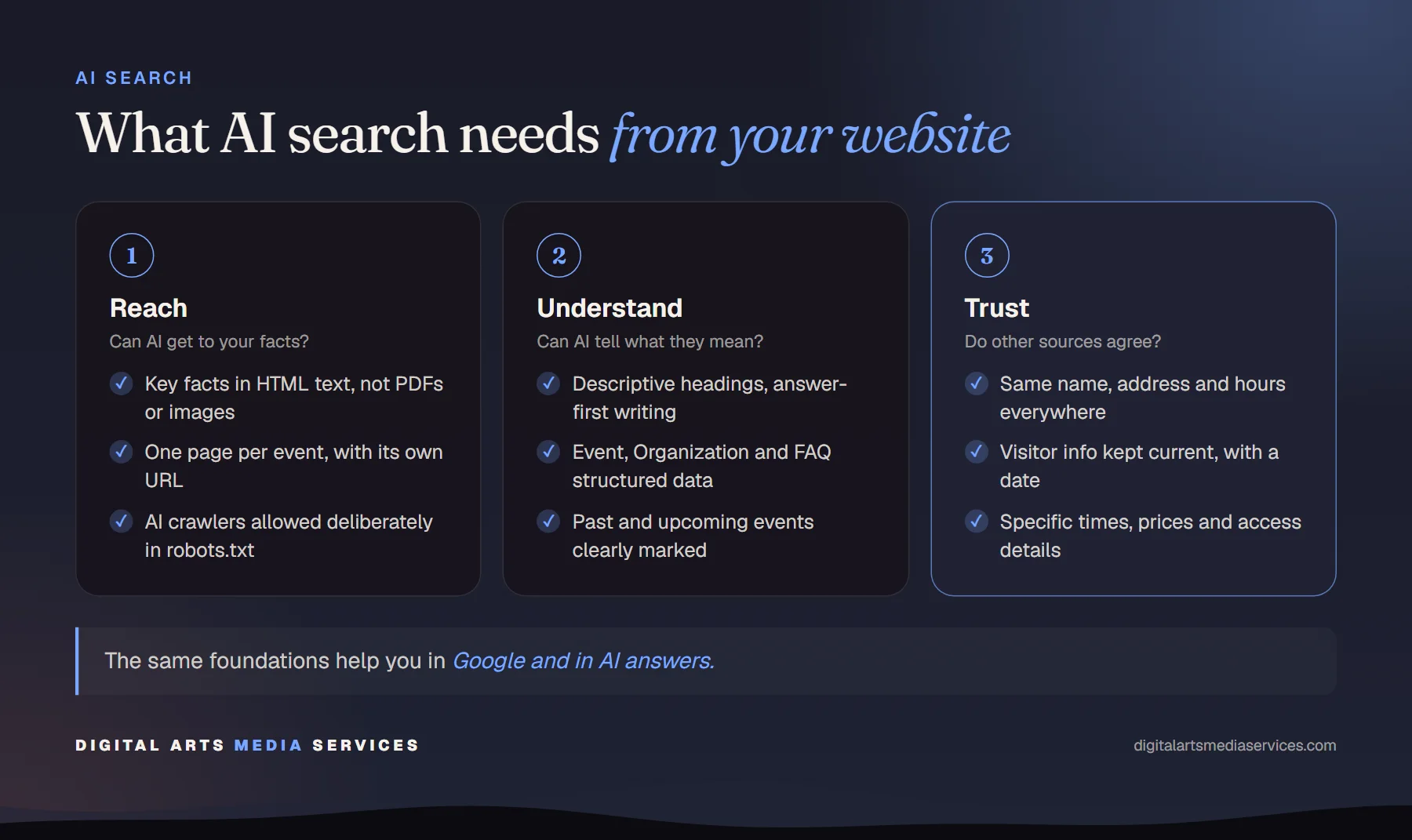
The details differ between products and change frequently, so it is wise not to chase any single tool’s quirks. What they have in common is that they need to:
- Reach your pages. Content behind logins, inside images or locked in hard-to-parse files is harder for them to use.
- Understand your pages. Clear headings, plain text and structured data reduce guesswork.
- Trust your pages. Information that matches what other reputable sources say is more likely to be used and cited.
If your website does those three things well, you are in a strong position for both classic search and AI search.
What makes an arts website easy for AI to read?
Many arts websites look beautiful but hide their most useful facts in places machines struggle with. The season brochure is a PDF. The opening hours are part of a banner image. The accessibility information is on a page nobody links to.
Some practical fixes:
- Put key facts in HTML text. Dates, times, venues, prices, opening hours, parking and accessibility details should appear as real text on the page, not only in images, PDFs or embedded widgets.
- Give every event its own page. A dedicated URL for each production, concert or exhibition, with a clear title, dates, venue, running time, price range and a link to buy tickets.
- Keep past and future clear. Mark past events as past, and remove or archive outdated details so AI tools do not repeat last season’s information.
- Write descriptive headings. “Parking and directions” is more useful to a reader, human or AI, than “Plan your visit” alone.
- Make it fast and accessible. Alt text, captions and a sensible heading structure help visitors using assistive technology, and they also make your content clearer to software.
If your ticketing system feeds your website, make sure event details appear in the page itself and not only inside a script that loads later. This is one reason we build Tessitura-connected websites that render the season as real HTML pages.
Does structured data matter for AI search?
Structured data is code on your pages, usually in a format called JSON-LD, that labels your information using the shared vocabulary from Schema.org. It tells software that a particular string is an event date, a venue address or a ticket price.
| Schema type | What it describes | Where to use it |
|---|---|---|
| Organization | Your name, logo, address, contact details and social profiles | Homepage or about page |
| Event | Name, dates, venue, performers, ticket offers and availability | Every event or performance page |
| FAQPage | Questions and answers | Visitor information and FAQ pages |
| Place or Museum | Location, hours and accessibility | Venue and visit pages |
| BreadcrumbList | Where a page sits in your site | Site-wide |
Search engines have long used structured data to show rich results, and it removes ambiguity for any system reading your pages. It does not guarantee you will be cited, but it makes accurate citation much easier. Check your markup with a structured data testing tool after any site update, since broken markup is common and easy to miss.
Why do consistent listings matter?
AI tools compare sources. If your website says the box office opens at noon, your Google Business Profile says 10 a.m. and an old directory listing says the box office is closed on Mondays, an assistant may repeat the wrong one or hedge its answer.
Review these regularly:
- Your Google Business Profile and other map listings
- Ticketing and event listing sites that carry your performances
- Local tourism and arts council directories
- Your social media profiles
- Wikipedia or other reference sites, where appropriate and following their rules
Your name, address, phone number, hours and website address should match everywhere. Holiday hours and seasonal changes are where mismatches usually creep in.
How should arts organizations write for AI answers?
Write the way a helpful box office manager talks: answer first, then the detail.
- Lead with the answer. If a page is about family tickets, the first paragraph should say who qualifies and how much they cost.
- Use the words your audience uses. People ask “Is there parking near the theater?” not “Ancillary visitor amenities.”
- Answer real questions. Your box office and front-of-house staff know the top 20 questions visitors ask. Each one deserves a clear answer on your site.
- Be specific. Exact times, prices, age guidance and accessibility features are more useful, and more quotable, than general enthusiasm.
- Keep it current. Add a visible “last updated” date to visitor information pages and actually update them.
This style helps AI tools pull a clean answer from your page, and it helps every human visitor too.
What is llms.txt, and is it worth adding?
llms.txt is a proposed convention: a plain-text Markdown file at the root of your website (yoursite.org/llms.txt) that gives AI tools a short summary of your organization and links to your most important pages. Think of it as a curated table of contents written for machines.
It is worth being honest about what it does. Support varies between AI products, and adding one is not a ranking guarantee. It is quick to create, costs nothing and does no harm, so it is a reasonable addition once the fundamentals above are in place. It is not a substitute for good pages.
Should you allow AI crawlers in robots.txt?
Your robots.txt file tells automated crawlers which parts of your site they may visit. Several AI companies publish the names of their crawlers so site owners can allow or block them, and some distinguish between crawlers used for training and those used to fetch pages when a user asks a question.
This is a genuine choice, and it deserves a deliberate decision rather than a default:
- Allowing AI crawlers makes it more likely your events and visitor information appear accurately in AI answers.
- Blocking them may keep your content out of some training data, but can also keep your organization out of AI recommendations.
- A middle path is possible: allow access to public visitor and event information while restricting areas such as member content.
Check each provider’s current documentation, as crawler names and policies change. Whatever you decide, make sure your robots.txt reflects it intentionally. Your AI policy is a good place to record the decision.
How can you measure visibility in AI search?
Measurement is still maturing, but you can learn a lot with simple checks:
- Referral traffic. Look in your analytics for visits that come from AI assistants and AI search products.
- Regular spot checks. Once a month, ask the major assistants the questions your audience asks: “What’s on at [your venue] this month?” or “Is [your museum] wheelchair accessible?” Note whether the answers are accurate and whether they cite your site.
- Search Console data. Keep watching impressions and clicks for your key pages, since AI answers in search draw on the same index.
- Fix what is wrong. When an assistant gets something wrong, trace it to the source, usually an outdated page or listing, and correct it.
What should you avoid?
- Publishing AI-generated filler. Pages written to game AI search tend to be thin and generic, and they can weaken trust in the rest of your site.
- Hiding text for machines. Content shown to crawlers but not to visitors violates search engine guidelines and can backfire.
- Chasing every new trick. AI search changes quickly. Accurate, accessible, well-structured content stays useful through those changes.
- Forgetting the box office. If AI tools send people to outdated pages, your staff will hear about it. Keep visitor information current.
For a wider look at practical AI uses beyond search, see our guide to AI for arts organizations and our overview of AI for arts organizations.
Want to know how AI sees your organization?
We help arts organizations get found in Google and AI search with technical SEO, structured data and websites built to be read by people and machines alike. If you would like a review of how AI assistants describe your organization today, book a free consultation. We typically reply within 24 hours.
Frequently asked questions
How do ChatGPT and Gemini decide which arts organizations to mention?
AI assistants draw on what they learned in training and, increasingly, on live web searches when they answer a question. They tend to cite pages that are crawlable, clearly written and consistent with other sources. The exact methods differ by product and change often, so the most reliable strategy is strong, accurate content on your own website.
Does structured data help with AI search?
Structured data such as Event, Organization and FAQ markup describes your information in a machine-readable format. It is widely used by search engines, and it helps any system reading your pages understand what is a date, a venue or a price. It does not guarantee placement, but it removes ambiguity.
What is llms.txt and do we need one?
llms.txt is a proposed convention: a plain-text Markdown file at the root of your site that summarizes your organization and links to your key pages for AI tools. It is optional and support varies between AI products. It is quick to add and does no harm, but it is not a substitute for good pages.
Should we block AI crawlers in robots.txt?
It depends on your goals. Blocking AI crawlers may keep your content out of some AI training sets, but it can also keep your organization out of AI-generated answers and recommendations. Many arts organizations that want to sell tickets choose to allow them, while protecting content they do not want reused.
How can we tell if AI search is sending us visitors?
Check your analytics for referral traffic from AI assistants and AI search products, and watch for changes in branded searches. You can also ask the major assistants common questions about your organization and note whether the answers are accurate and cite your site.